
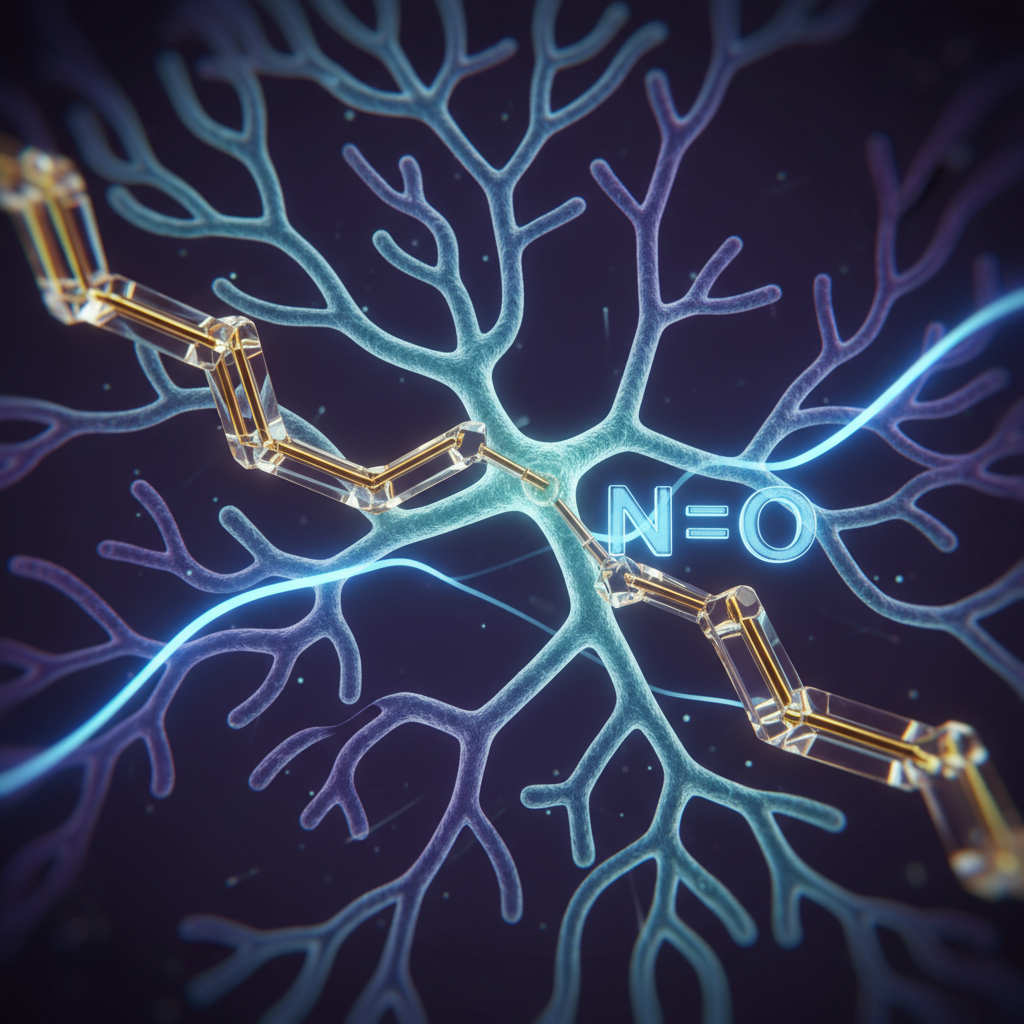
Introduction: BPC-157 as a Vascular Research Tool
Pentadecapeptide BPC-157 (Body Protection Compound-157), a 15-amino acid sequence derived from human gastric juice protein, has attracted sustained scientific interest due to its pleiotropic activity across multiple physiological systems. Among the most compelling areas of investigation is its interaction with the nitric oxide (NO) system — a central regulator of vascular tone, endothelial homeostasis, and angiogenic signaling.
First characterized and extensively studied by Sikiric and colleagues at the University of Zagreb, BPC-157 has demonstrated consistent activity in rodent and in vitro models involving NO-dependent pathways. For researchers focused on vascular biology, endothelial dysfunction, or angiogenesis, understanding BPC-157's mechanistic relationship with the NO system is of considerable translational relevance.
All research discussed herein pertains to preclinical models. BPC-157 is intended for in vitro and animal research use only and is not approved for human therapeutic application.
The Nitric Oxide System: A Brief Mechanistic Overview
Nitric oxide is a gaseous signaling molecule synthesized endogenously by nitric oxide synthase (NOS) enzymes — principally endothelial NOS (eNOS), neuronal NOS (nNOS), and inducible NOS (iNOS). Within the vascular compartment, NO produced by eNOS mediates vasodilation via cyclic GMP (cGMP) upregulation in vascular smooth muscle cells, while also modulating platelet aggregation, leukocyte adhesion, and endothelial permeability.
Dysregulation of NO bioavailability is implicated in a spectrum of vascular pathologies including atherosclerosis, hypertension, and impaired wound healing. Compounds that modulate NOS activity or NO bioavailability therefore represent important mechanistic tools in vascular research.
BPC-157 and NO Pathway Interactions: Key Findings
Modulation of eNOS and iNOS Expression
Sikiric et al. have published extensively on BPC-157's capacity to interact with the NO system in a context-dependent manner. Notably, research has demonstrated that BPC-157 can attenuate the overactivation of iNOS in inflammatory models while simultaneously preserving or upregulating eNOS-mediated signaling in endothelial tissue. This differential modulation is mechanistically significant: it suggests a regulatory rather than simply suppressive or stimulatory role on NO synthesis.
In models of NOS blockade — where L-NAME (Nω-nitro-L-arginine methyl ester) was used to induce NO deficiency — BPC-157 administration was associated with restoration of vascular responses and mitigation of hypertensive sequelae, pointing toward a compensatory interaction with NO-dependent regulatory circuits.
Interaction with the NO-cGMP Axis
BPC-157 has demonstrated activity consistent with downstream engagement of the NO-cGMP signaling axis. In vascular smooth muscle preparations and wound model tissues, the peptide's pro-angiogenic effects have been partially linked to modulation of this pathway, suggesting that its angiogenic properties may not operate entirely independently of NO bioavailability. Research data indicate that:
- BPC-157 upregulates VEGFR2 expression, a receptor integrally connected to eNOS phosphorylation cascades
- Its administration is associated with increased endothelial cell migration and tubulogenesis in in vitro angiogenesis assays
- Effects on vessel formation are partially attenuated in NO-depleted experimental environments, implicating NO system dependency
Counteraction of NO System Disruption
A particularly well-documented area involves BPC-157's counteraction of pathologies induced by NO system disruption. Sikiric's group has demonstrated in multiple publications that BPC-157 can rescue vascular and gastrointestinal tissue function following pharmacological blockade of NO synthesis. These findings were consistent across models of colitis, fistula healing, and peripheral vascular compromise — suggesting a broad cytoprotective interface with NO-dependent tissue homeostasis.
This is particularly relevant to researchers investigating endothelial dysfunction models, where BPC-157 may serve as a useful experimental comparator or mechanistic probe for NO system rescue pharmacology.
Angiogenesis: BPC-157 and Vascular Remodeling Research
Angiogenesis — the formation of new blood vessels from existing vasculature — is fundamentally regulated by NO-dependent signaling. eNOS-derived NO facilitates endothelial proliferation, lumen formation, and the integration of new vessels into existing networks. BPC-157's angiogenic profile has been characterized in several preclinical models and represents one of its most robustly documented activities.
Studies utilizing Matrigel plug assays and wound-healing models have demonstrated accelerated neovascularization in BPC-157-treated subjects relative to controls. Molecular characterization of these effects has identified upregulation of:
- VEGF (Vascular Endothelial Growth Factor) and its cognate receptor VEGFR2
- FAK (Focal Adhesion Kinase) and paxillin signaling — key mediators of endothelial cell motility
- eNOS phosphorylation at Ser1177, a principal activation site linked to NO release
The convergence of these molecular signatures suggests that BPC-157's angiogenic activity is mechanistically intertwined with NO system engagement, rather than operating through an entirely parallel signaling axis.
Research Considerations and Model Selection
For investigators designing experiments around BPC-157 and NO system interactions, several methodological considerations are worth noting:
- Dose-response characterization: BPC-157 has demonstrated activity across a wide concentration range in published rodent studies (typically µg/kg range), and establishing dose-response curves in your specific model is advisable prior to mechanistic interpretation.
- NOS inhibitor co-administration: Paired experiments utilizing L-NAME or L-NMMA alongside BPC-157 can help delineate NO-dependent versus independent mechanisms in your system of interest.
- Endothelial cell lines: HUVEC (Human Umbilical Vein Endothelial Cell) models have been employed in published work and represent a well-validated in vitro platform for assessing BPC-157's vascular effects.
- Oxidative stress co-markers: Given NO's interaction with reactive oxygen species (superoxide generating peroxynitrite), measuring 3-nitrotyrosine or eNOS uncoupling markers may provide mechanistic resolution in inflammatory vascular models.
Summary and Research Outlook
The body of preclinical evidence reviewed here positions BPC-157 as a mechanistically rich compound for vascular and NO system research. Its capacity to modulate eNOS and iNOS activity in context-dependent fashion, support angiogenic signaling through VEGF-NO axis engagement, and counteract pharmacologically induced NO deficiency makes it a compelling research tool across multiple experimental paradigms.
Future directions of particular interest include elucidating the precise receptor or binding partner through which BPC-157 exerts its NO system effects — a question that remains open in the literature — as well as characterizing its interaction profile in human endothelial cell systems and organoid vascular models.
RP Wellness supplies research-grade BPC-157 manufactured to strict purity standards for use in qualified preclinical research settings. All products are intended exclusively for in vitro and animal research purposes.