
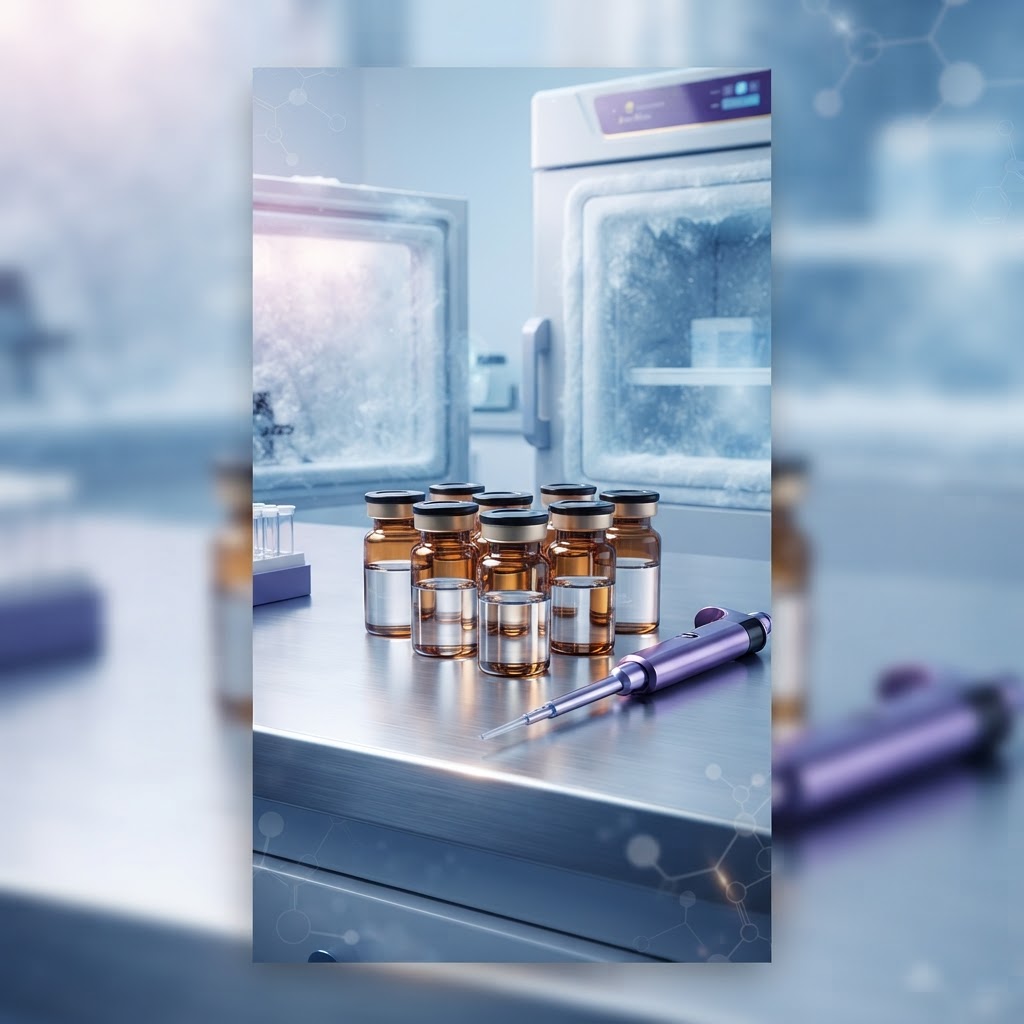
The Question Every Researcher Should Be Asking Before They Reconstitute
You've sourced your peptide, your lab bench is prepped, and reconstitution is next. But here's the question that often comes too late: once you add that solvent, how long do you actually have before the peptide degrades?
For laboratory researchers and analytical scientists, peptide stability isn't just a minor footnote — it directly affects experimental reproducibility, data integrity, and research outcomes. Yet most resources online offer little more than a temperature range and call it a day. This guide goes deeper.
Lyophilized vs. Reconstituted Storage: Understanding the Core Difference
Before diving into timelines, it's essential to understand what is the difference between lyophilized and reconstituted storage — because the distinction is significant.
Lyophilized (Freeze-Dried) Peptides
Lyophilization removes water from the peptide under vacuum, locking it into a highly stable powder form. In this state, the peptide has minimal molecular mobility, which dramatically slows oxidation, hydrolysis, and other degradation pathways.
- Storage temperature: −20°C (long-term) or 4°C (short-term, up to several months)
- Shelf life: Typically 1–3 years or longer when stored correctly at −20°C
- Stability advantage: No water activity means far slower chemical degradation
- Best practice: Store desiccated, protected from light, in a sealed container
Lyophilized peptides represent the gold standard for long-term storage. If you're not using a peptide immediately, keeping it in its lyophilized state is always preferred.
Reconstituted Peptides (in Solution)
Once a peptide is dissolved in a solvent — typically sterile water, bacteriostatic water, or an appropriate buffer such as acetic acid — its stability profile changes considerably. Water reintroduces the primary drivers of degradation: hydrolysis, oxidation, and microbial contamination.
- Storage temperature: 4°C for short-term use (days to weeks); −20°C for extended storage (weeks to months)
- Typical stability window: 4–8 weeks at 4°C; up to 3–6 months at −20°C, depending on the peptide sequence
- Key variable: Peptide sequence composition — cysteine, methionine, and asparagine residues are especially prone to degradation in solution
"The stability of a reconstituted peptide is not universal — it is sequence-dependent, solvent-dependent, and highly sensitive to storage conditions. Researchers should treat every reconstituted peptide as a time-sensitive reagent."
How Long Are Peptides Stable After Reconstitution?
This is the core question — and the honest answer is: it depends, but there are clear evidence-based benchmarks to guide you.
General Stability Timelines for Reconstituted Peptides
- At room temperature (20–25°C): Most peptides degrade within hours to a few days. Room temperature storage is not recommended for any extended period.
- At 4°C (refrigerated): Many peptides remain stable for approximately 2–6 weeks, assuming sterile technique during preparation and appropriate solvent selection.
- At −20°C (frozen): Stability extends to approximately 1–6 months for most peptides. Repeated freeze-thaw cycles should be avoided — aliquot your reconstituted peptide before freezing.
- At −80°C: For highly sensitive or complex peptides, ultra-low temperature storage can extend stability further, approaching lyophilized-like timeframes in some cases.
Peptides containing disulfide bonds, free cysteines, or asparagine-glycine sequences are the most vulnerable in solution. When in doubt, consult the specific stability data for your peptide sequence or reach out to your supplier's research team.
Aliquoting: The Single Most Impactful Practice
Preparing single-use aliquots before freezing is one of the most effective ways to preserve reconstituted peptide integrity. Each freeze-thaw cycle introduces mechanical stress and oxidative risk. By aliquoting into amber vials or low-binding microcentrifuge tubes, you minimize cumulative degradation across your experiment timeline.
Does Light Exposure Affect Peptide Integrity?
Yes — and this is an area where many researchers underestimate the risk. Does light exposure affect peptide integrity? Absolutely, particularly for certain amino acid-containing sequences.
UV and visible light can catalyze photooxidation reactions, particularly affecting:
- Tryptophan (Trp) — highly susceptible to UV-induced degradation
- Tyrosine (Tyr) — moderate photosensitivity
- Phenylalanine (Phe) — lower but present photosensitivity
- Cysteine (Cys) — can undergo light-accelerated oxidation forming unwanted disulfide bonds
The practical implication: always store peptides in amber or opaque vials, minimise bench-time exposure during reconstitution, and work under low-UV lighting conditions when possible. This is especially critical for reconstituted solutions, which are already in a more vulnerable state than lyophilized powders.
Peptide Storage Guidelines: A Quick-Reference Summary
- ✅ Store lyophilized peptides at −20°C, desiccated, protected from light and moisture
- ✅ Reconstitute only the amount needed for immediate experimental use when possible
- ✅ Use bacteriostatic water or sterile-filtered buffer appropriate to the peptide's solubility profile
- ✅ Aliquot reconstituted solutions before freezing; avoid repeated freeze-thaw cycles
- ✅ Store reconstituted peptides at 4°C for short-term use, −20°C for extended use
- ✅ Use amber vials and minimize light exposure at all stages
- ✅ Label all vials with reconstitution date and solvent used for traceability
- ⛔ Do not store reconstituted peptides at room temperature beyond same-day experimental use
Why Storage Protocol Matters for Research Integrity
In analytical and in vitro research settings, degraded peptides introduce confounding variables that can skew assay results, reduce potency readings, or produce altogether unreliable data. When your research depends on reproducibility, storage protocol is not optional — it's methodology.
At RP Wellness, all peptides are supplied in lyophilized form with purity verification via HPLC and mass spectrometry. This gives researchers the highest-quality starting material — but maintaining that quality through proper handling is equally essential.
All RP Wellness peptides are intended strictly for laboratory, in vitro, and analytical research purposes. They are not intended for human or animal consumption.