
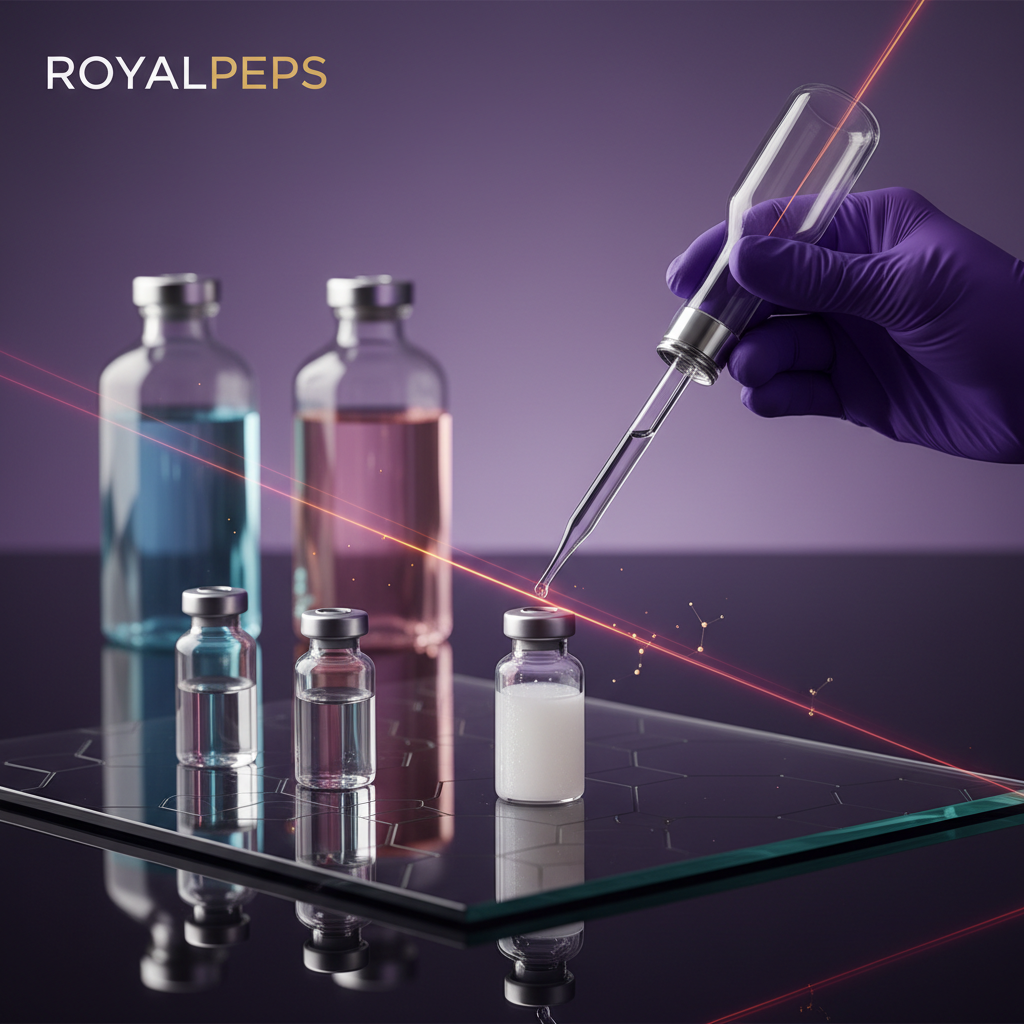
Why Solubility Matters in Peptide Research
One of the most common frustrations in peptide research isn't sourcing — it's reconstitution. You've received your lyophilized peptide, you add solvent, and... it won't dissolve. Or worse, it appears dissolved but has actually aggregated at a molecular level, skewing your entire experiment.
Getting peptide solubility right is foundational. The wrong solvent can denature your peptide, cause irreversible aggregation, or simply yield an unusable preparation. This guide is your go-to reference for matching peptides to the right solvent — every time.
All peptides and research compounds discussed here are strictly intended for in vitro and laboratory research use only. They are not approved for human consumption or clinical application.
Understanding the Basics: What Drives Peptide Solubility?
Peptide solubility is largely governed by the amino acid composition and the overall charge of the molecule at a given pH. A few key principles to keep in mind:
- Hydrophilic peptides (rich in charged residues like Arg, Lys, Asp, Glu) typically dissolve well in aqueous solutions.
- Hydrophobic peptides (rich in Leu, Val, Ile, Phe, Trp) resist water and often require organic co-solvents.
- Net charge at neutral pH is a reliable predictor — positively charged peptides favor acidic solvents; negatively charged peptides favor basic solvents.
- Sequence length matters too — longer peptides have more opportunities for internal hydrogen bonding and aggregation.
Before reaching for a solvent, always check the peptide's amino acid sequence, isoelectric point (pI), and any supplier-provided reconstitution notes.
The Main Solvents — When to Use What
💧 Sterile Water or PBS — The First Choice
For most hydrophilic peptides, sterile water (or phosphate-buffered saline for physiological pH experiments) is the simplest and safest starting point. If your peptide has a net positive or negative charge and contains few hydrophobic residues, try water first.
Best for: Short, charged peptides; peptides with >75% hydrophilic residues; general aqueous assay preparations.
Tip: Always use bacteriostatic or sterile water to avoid microbial contamination in your stock solutions. Add solvent slowly and gently swirl — avoid aggressive vortexing which can introduce bubbles or shear stress.
🧪 Acetic Acid (0.1%–1%) — The Go-To for Basic Peptides
Dilute acetic acid is the workhorse solvent for peptides with a net positive charge (i.e., those rich in Lys, Arg, or His residues). The mild acidity protonates basic side chains, increasing electrostatic repulsion between peptide molecules and driving dissolution.
Best for: Positively charged peptides; growth hormone-related peptides; many common research peptides including GHRPs and GHRHs.
Tip: Start with 0.1% acetic acid in sterile water. If solubility is still poor, increase to 0.5% or 1%. Avoid concentrations above 1% as they may affect downstream assay conditions.
🔬 Ammonium Bicarbonate (NH₄HCO₃) — For Acidic Peptides
When your peptide carries a net negative charge (rich in Asp or Glu residues), a dilute basic solution like ammonium bicarbonate (5–10 mM) helps by deprotonating acidic side chains and increasing solubility.
Best for: Negatively charged or acidic peptides; peptides where acetic acid shows no effect.
Tip: Ammonium bicarbonate is volatile and relatively benign, making it a preferred alternative to stronger bases like NaOH for research preparations.
🧫 DMSO (Dimethyl Sulfoxide) — The Hydrophobic Peptide Solver
DMSO is the go-to solvent for hydrophobic peptides that refuse to dissolve in aqueous media. As an aprotic polar solvent, DMSO disrupts peptide-peptide interactions and forces molecules into solution.
Best for: Highly hydrophobic peptides; cyclic peptides; peptides with large aromatic residues (Trp, Phe, Tyr).
Tip: Dissolve the peptide in a minimal volume of DMSO first (often just 10–20% of total volume), then dilute with your aqueous buffer. Keep the final DMSO concentration below 1% for most cell-based assays, as higher concentrations can be cytotoxic and confound results. Always note the final DMSO concentration in your experimental records.
🔄 Blended Solvents — When One Isn't Enough
Some peptides — particularly longer or more complex sequences — resist any single solvent. In these cases, a blended approach works best:
- DMSO + Water: Dissolve in DMSO, dilute with sterile water or PBS.
- Acetonitrile + Water: Useful for analytical preparations (HPLC); less common for biological assays.
- TFE (Trifluoroethanol): Effective for highly aggregation-prone peptides; typically used at low percentages.
- Isopropanol + Water: Occasionally used for amphipathic or membrane-associated peptides.
When using blends, always add the organic solvent to the peptide first, achieve a clear solution, then introduce the aqueous component gradually.
Practical Reconstitution Tips for the Lab
- Start small: Test with a small aliquot before committing your full stock. Solubility can sometimes surprise you.
- Gentle sonication: A brief pulse in an ultrasonic bath (30–60 seconds) can assist dissolution without degrading the peptide.
- Warm slightly: For stubborn peptides, warming the solution to 37°C briefly can help — avoid prolonged heat exposure.
- Check for aggregation: A clear solution isn't always a true solution. Use dynamic light scattering (DLS) or absorbance spectroscopy if accuracy is critical.
- Store stock solutions properly: Aliquot into single-use volumes, freeze at -20°C or -80°C, and avoid repeated freeze-thaw cycles.
Quick Reference: Peptide Solvent Selection Chart
- Hydrophilic, neutral pH: Sterile water or PBS
- Net positive charge (basic peptide): 0.1–1% Acetic acid in water
- Net negative charge (acidic peptide): 5–10 mM Ammonium bicarbonate
- Hydrophobic or cyclic: DMSO (then dilute with buffer)
- Highly aggregation-prone: TFE or DMSO blends
A Note on Research Integrity
Proper research preparation isn't just a technical detail — it directly impacts the validity of your data. An improperly reconstituted peptide can yield false negatives, inconsistent dose-response curves, or outright failed experiments. Taking the time to choose the right solvent and validate your preparation method is part of rigorous, reproducible science.
At RP Wellness, all our peptides ship with purity certificates and are accompanied by available reconstitution guidance. As always, these compounds are supplied exclusively for laboratory and in vitro research purposes and are not intended for human or veterinary use.